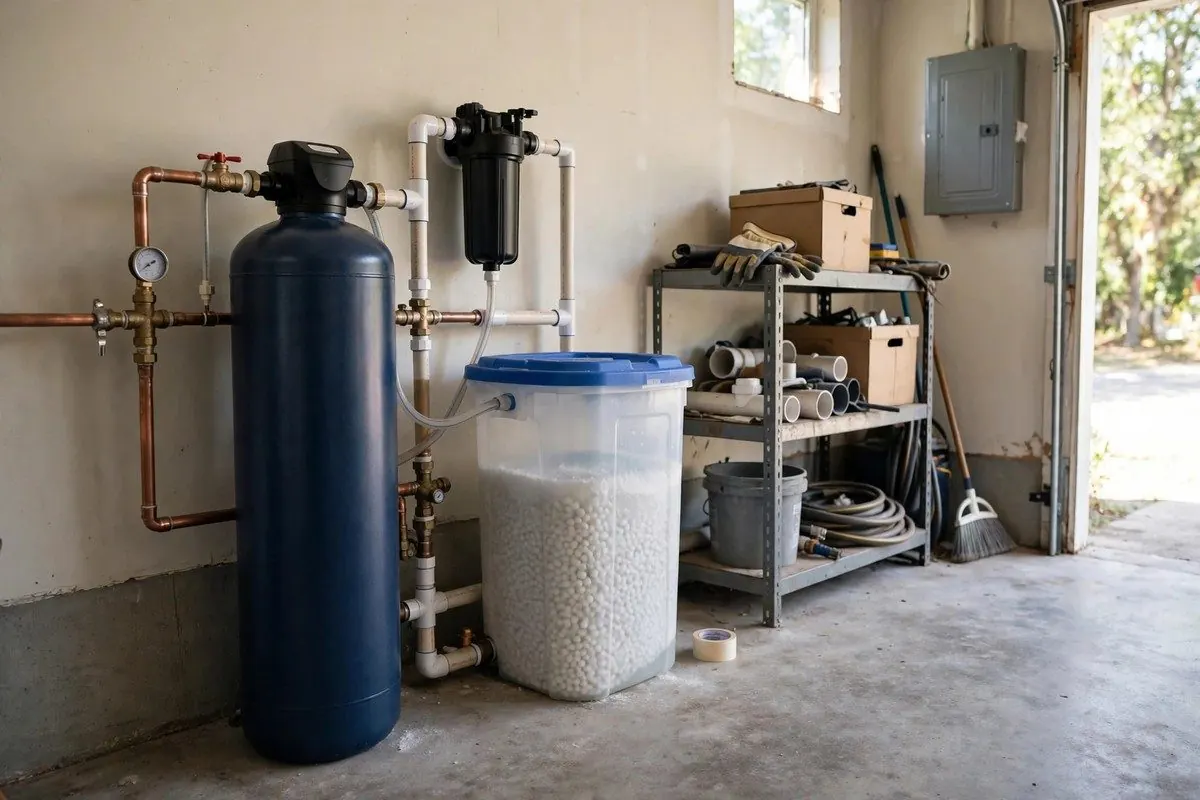
Water Softener & Filtration in Wasco, CA
A water softener installation in Wasco, CA connects a treatment tank to your main supply line so hardness minerals are removed before the water reaches your fixtures.
Softeners, carbon filters and reverse osmosis units solve different problems, and the right pick starts with a test of your own tap.
Crusty faucets, cloudy glasses and chlorine taste are three different problems
White crust on faucet tips and showerheads, spots on dishes and a film in the tub usually point to hardness minerals. A chlorine smell or taste is a separate issue, and so is a flat or off taste at the kitchen sink. Mixing these up is how people end up with a tank they did not need.
A plumber can tell which problem you have by looking at the fixtures, the water heater and a simple test of the water. That is why the first call is about what you see, and the equipment comes second.
Softener, filter or reverse osmosis: what each one is for
These are not interchangeable. Pick by the problem you want gone.
| Option | What it does | What it does not do | Where it goes |
|---|---|---|---|
| Salt-based softener | Removes hardness minerals that cause scale and spotting | Does not work as a general filter or fix taste on its own | At the main line, whole house |
| Carbon filter | Reduces chlorine taste and odor | Does not soften water | Whole house or at one tap |
| Reverse osmosis unit | Treats drinking and cooking water through a membrane | Slow, small volume, not meant for the whole house | Under the kitchen sink |
| Combination setup | Softener for scale plus a tap-level filter for taste | Costs more and has more parts to service | Main line plus sink |
Most households need one of these, not all four. If you are unsure, describe what you notice on the call and the plumber can match the equipment to the complaint.
Not sure which unit fits?
Describe the spots, scale or taste you notice and what your test showed. A plumber will tell you whether a softener, a filter or nothing at all makes sense.
Test your tap before you buy anything
Hardness is easy to measure and expensive to guess. Test strips from a hardware store give a rough number, and a lab test gives a precise one. Take the sample from a cold tap that has not been softened.
Then compare your result with your city's annual water quality report. The result tells you how big a tank you need, and whether you need one at all.
Wasco, Shafter and McFarland publish very different hardness numbers
The City of Wasco's 2022 water quality report does not list hardness, so a Wasco homeowner has no city number to start from. Test the tap, and check the city's newer reports for hardness before sizing equipment.
The neighbors report it, and the gap is wide. Shafter's 2025 report gives total hardness of 92.17 ppm on average, with individual wells from 17 to 207 ppm, while its 2024 report averaged 128.85 ppm. McFarland's 2025 report lists hardness of 11 ppm, with a range of 7 to 32.4 ppm.
That means a softener that makes sense for one address in Shafter may be pointless in McFarland. Wells can differ from one part of a city to another, so your own test beats the citywide average.
Ask your city about salt discharge
California has no statewide ban on salt-based softeners. According to California's Water Code, a local agency that runs a community sewer system may regulate residential self-regenerating softeners, but only after a regional water board finding and a public hearing, and the options include barring new units.
The law names the San Joaquin River and Tulare Lake regions among those covered. We have not confirmed whether any local agency in Wasco, Shafter or McFarland has adopted such a rule, so ask your city before installing a self-regenerating softener.
What an installation actually involves
The work is mostly plumbing, and the details decide whether the unit works quietly for years.
- Pick the spotA garage wall, side yard or utility closet near the main line, with room for the tank and brine tank and a nearby electrical outlet.
- Cut into the mainThe plumber shuts the water, cuts into the supply line and sets inlet, outlet and a bypass valve so the water can be routed around the tank for service.
- Route the drainThe unit sends rinse water to a drain through an air gap, so the line must reach an approved drain and be secured.
- Check pressureWhere static pressure runs above 80 psi, the California Plumbing Code calls for a regulator, and high pressure is hard on tank valves.
- Set and testThe head is programmed for your hardness, the system is flushed, and the plumber checks fittings for drips before leaving.
Reverse osmosis and what the Wasco report lists
People often ask about reverse osmosis after reading the city's water quality report. The city's 2022 report lists nitrate and 1,2,3-TCP results and lists 1,2,3-TCP as a violation, and the city describes plans for new wells and carbon treatment at one existing well. Read that report and call the city's water utility for current results.
A softener is built for hardness minerals, not for those. We install the equipment you choose, but we do not diagnose water-quality health risks or promise that a tap unit removes a given contaminant. If that is your goal, check what a product is certified to remove before you buy.
What shapes the price of a softener or filter job
A clear price comes after the plumber sees the location, the piping and the equipment.
Water treatment is rarely an insurance matter unless it is part of a repair. If you want your real number, call the number on this page and say what you want fixed.
A softener changes how the rest of the plumbing is set up
Where the tank connects matters for the water heater. Soft water flows to the heater and fixtures, so many installers plan the tank ahead of the heater and keep outdoor hose bibs on the untreated line. If you are also thinking about a new water heater, planning both jobs together saves a second cut into the main.
Scale also stays on old fixtures until it wears off. Expect crusty aerators to need a soak or replacement, and do not expect spots to vanish the day after install. Other new fixtures and lines are covered under plumbing installation.
Existing softener or conditioner that has stopped working
A tank that no longer regenerates, a salt bridge, a cracked valve from a move or a leaking brine line are common reasons for a service call. Tell dispatch the make and what you notice on the control head.
If the unit is leaking, turn the bypass valve and call. The work can be handled as plumbing under the C-36 plumbing classification, which includes water conditioning equipment. You can check any contractor's license at the CSLB website.
Water treatment questions we hear
We cannot say from here. The City of Wasco's 2022 report does not list hardness, so test your own tap with strips or a lab test. Scale on fixtures and the water heater is the practical clue.
A softener is not designed for those. We do not diagnose water-quality health risks, so read the city's report and ask the water utility. If you want a drinking-water unit, ask what the product is certified to treat.
California leaves that to local sewer agencies. Ask your city before installing a self-regenerating softener, since we have not confirmed what applies in Wasco, Shafter or McFarland.
A permit may be required. Ask the city building department or have the plumber check before the work starts. We do not guess at permit rules.
Yes. It mounts under the sink with a small faucet, and the plumber ties it to the cold line and a drain. It makes a small amount of treated water at a time.
Set the bypass valve, unplug the control head if water is near it, and call. A leak that is spraying means closing the main valve. We can send a licensed plumber on a same-day appointment when available.
Ask the owner first, since it cuts into the main line and may need a permit. Property managers who want a unit installed can call with the address and the plumber will scope it.
Book a softener or filter install
Call with your tap results and the spot you have in mind. You will hear a clear price before work starts, and plumbing questions get a straight answer.