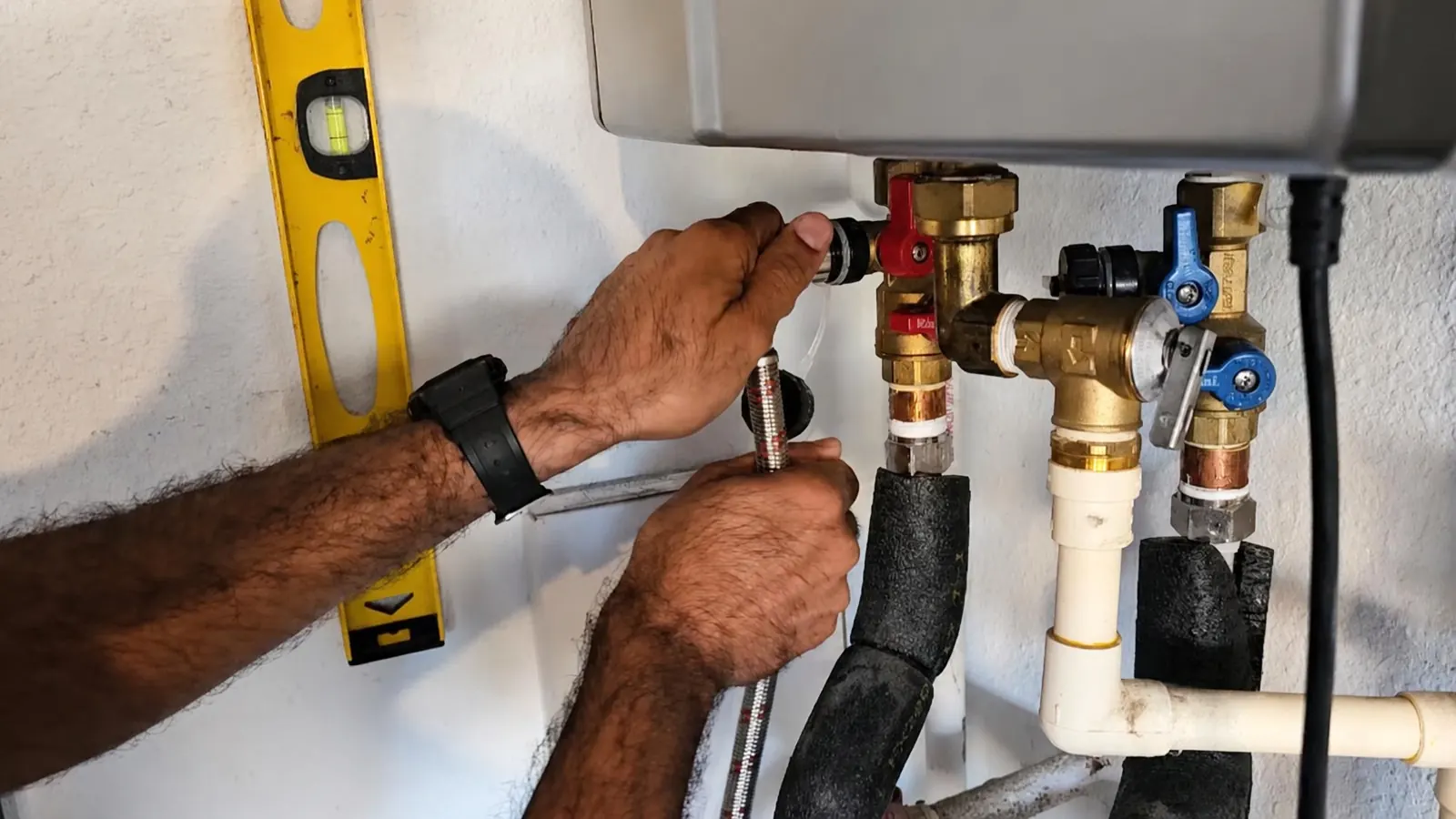
Tankless Water Heater in Wasco, CA
A tankless unit that flashes an error, runs lukewarm, or has never been flushed deserves a proper look.
A licensed plumber from our dispatch network installs, repairs and services tankless heaters, and says plainly when a tank is the better choice.
Lukewarm, erratic or error codes: what tankless trouble looks like
A tankless water heater heats water only as it flows, so it has no tank to hold a reserve. In Wasco, CA, a tankless water heater is a wall-mounted gas or electric unit that fires or energizes when a hot tap opens and shuts off when it closes. When something is wrong, it usually shows as water that fluctuates between hot and cold, a unit that shuts off mid-shower, or a display code.
Those symptoms trace back to a short list: scale inside the heat exchanger, a clogged inlet screen, a venting or gas supply problem, a failed sensor, or too little flow to trigger the unit. A plumber reads the code, checks the flow and gas or power supply, and narrows the cause before parts are touched.
If you are weighing a tankless purchase instead, the same logic applies in reverse. The decision depends on gas capacity, venting, water quality and how the household uses hot water.
Tank or tankless: how the two compare in a Wasco home
Neither type wins in every house. This comparison covers the points that actually change a decision.
| Question | Tank | Tankless |
|---|---|---|
| Hot water supply | Stored volume, can run out | Continuous while flow and fuel are adequate |
| Expected life (DOE) | 10 to 15 years | About 20 years |
| Space | Needs floor space | Wall-mounted, smaller footprint |
| Gas demand | Modest burner | Large burst of gas when running |
| Venting | Standard flue in most cases | Dedicated vent, often special material |
| Upkeep | Occasional flush and anode check | Yearly flush and descale |
| Retrofit effort | Usually a like-for-like swap | Often needs new gas line, vent or circuit |
The Department of Energy puts tankless life at about 20 years, but that figure assumes the unit is maintained. Skipping the yearly flush is the most common way to lose years.
Tankless on your mind, or acting up?
Call us with the brand, the symptom or your plan. A licensed plumber scopes the job and gives a clear price before work starts.
Gas or electric tankless: what each one demands from the house
Gas models need a lot of gas for a short time, so the existing line, its length and the meter capacity have to be checked before the unit is chosen. Sometimes the line is upsized. The vent is a dedicated run built to the maker's instructions, and a condensing model also needs a drain for acidic condensate.
Electric models pull heavy current, so they need a dedicated circuit and enough panel capacity. In many homes, that makes an electrician part of the job. A unit sized too small for the flow you ask of it will run lukewarm even when nothing is broken.
Gas work falls under the C-36 plumbing classification, which covers gas appliance connections. Check any plumber at cslb.ca.gov before you agree to a job. If you already own a tank and want to compare installs, planned water heater installation covers sizing and location for either type.
Annual flush and descale: what the service involves
Scale builds up inside the heat exchanger and narrows the passages water moves through. A yearly flush is the usual maker guidance, so check your manual and follow it.
- Power downThe unit is turned off and the gas or electric supply is isolated at its shutoff.
- Close the service valvesIsolation valves on the cold and hot lines let the unit be flushed without draining the house. If none exist, installing them is part of the first service.
- Connect a pump and hosesHoses link the flush ports to a small pump and a bucket, forming a loop through the heat exchanger.
- Circulate descalerA descaling solution runs through the loop for the time the manufacturer specifies, dissolving mineral deposits.
- Rinse and clean the screenThe loop is flushed with clean water, and the cold inlet screen is pulled and cleaned of debris.
- Restore and testValves reopen, air is purged, power or gas is restored, and the unit is run through a hot tap to confirm flow and temperature.
Hard water, scale and the city's water report
Scale depends on how much dissolved mineral your tap water carries, and that varies by city and sometimes by well. City of Wasco water comes from groundwater wells, and the city publishes an annual water quality report. Read the current one and look for hardness. If it is not listed, a hardness test strip kit from the hardware store or a lab test gives you a number for your own tap.
We do not quote a hardness figure for Wasco here, because only the city's report or your test is a reliable source. Shafter and McFarland publish their own reports with their own mineral values, and they differ from each other, so borrowing a neighbor's number is a mistake. We do not diagnose water-quality health risks, so take health questions to the city water department or your water utility.
If your numbers show heavy mineral content, a scale-prevention or softening setup can protect a tankless unit. Water softener installation explains the options, and the plumber can recommend a flush interval that fits.
Tankless repair: faults that come up most
The error code is a clue, not a verdict. These are the common causes a plumber tests.
- Scale in the heat exchanger Shows up as fluctuating temperature, noise or a code for overheating. Descaling often restores it.
- Clogged inlet screen Low flow and shutoffs. A quick clean is a small job.
- Venting or gas supply Ignition failure codes can trace to a blocked vent, low gas pressure or a closed valve.
- Sensors and boards Flow, temperature and flame sensors drift or fail. Some repairs are part swaps, while others call for the maker's parts.
- Leaks at connections Water at the unit may come from a valve, a connector or the heat exchanger. The source decides repair or replacement.
If the heat exchanger itself is leaking, repair is usually not practical. A tank-based water heater repair comes with different parts and different answers.
Tankless in a cold-night location
Bakersfield, the nearest National Weather Service station, shows an average January low near 40 F, so freeze nights can occur in the area. A unit on an exterior wall or in an exterior closet needs its manufacturer's freeze guidance followed, and exposed pipes benefit from insulation.
When tankless does not make sense
A good plumber will talk you out of a poor fit. These are the situations where a tank can be the smarter choice.
- The gas line cannot carry the load If upsizing is large or the route is impractical, the cost can outweigh the benefit.
- No workable vent route A unit that cannot be vented to the maker's rules cannot be installed.
- Very hard water and no plan to treat it Scale will shorten the life of the heat exchanger without a flush routine.
- Low-flow or tiny fixtures only Some units need a minimum flow to fire, and a trickle may not trigger them.
- You will not do the yearly service A skipped flush quietly takes years off the unit.
What a tankless job costs, by factor
Tankless quotes run wider than tank quotes because each house needs different support work. Here is what builds the number.
A flush and descale service is priced as a visit, not as an install. Insurance generally does not cover planned upgrades or maintenance. For a clear price before work starts, call the number on this page.
Tankless service across Wasco, Shafter and McFarland
Installing a tankless unit usually needs a permit and inspection from the city or county building department. For a home in Wasco, ask the City of Wasco building department. Ask your plumber how bracing and mounting requirements apply to your particular unit.
We work in Wasco, in Shafter, about 8 miles along State Route 43, and in McFarland. Same-day appointments are offered when available for repairs, such as a unit that has stopped heating.
Tankless questions we hear most
Many manufacturers call for a yearly flush and descale. Check your manual, and shorten the interval if your water carries a lot of minerals. A test strip or lab test tells you about your own tap.
The city's own water quality report is the source to check, and we do not quote a hardness number for Wasco. If it is not listed, test your tap. Scale is the main enemy of a tankless heat exchanger, so the answer drives how often you flush.
Common causes are scale, a clogged screen, low flow, a gas or vent fault, or two fixtures asking for more than the unit can deliver. A plumber checks the error code and the flow.
Usually yes, with support work. Gas models may need a larger gas line and a new vent, while electric models need a dedicated circuit and panel capacity. The plumber checks these before quoting.
The Department of Energy says tankless units last about 20 years, compared with 10 to 15 for storage tanks. Regular flushing is a large part of reaching that figure.
Yes, in most cases. Tell the dispatcher the brand and any error code displayed. Some repairs need manufacturer parts, which can mean a second visit.
Call the 24/7 line and ask for a same-day appointment. If the unit is leaking, shut the water supply to it and switch off its power or gas. If you smell gas, leave the building on foot and call SoCalGas or 911 from outside.
Keep a tankless unit running the way it was built to
Book the install, the repair or the yearly flush, and get an honest answer about whether tankless fits your home.