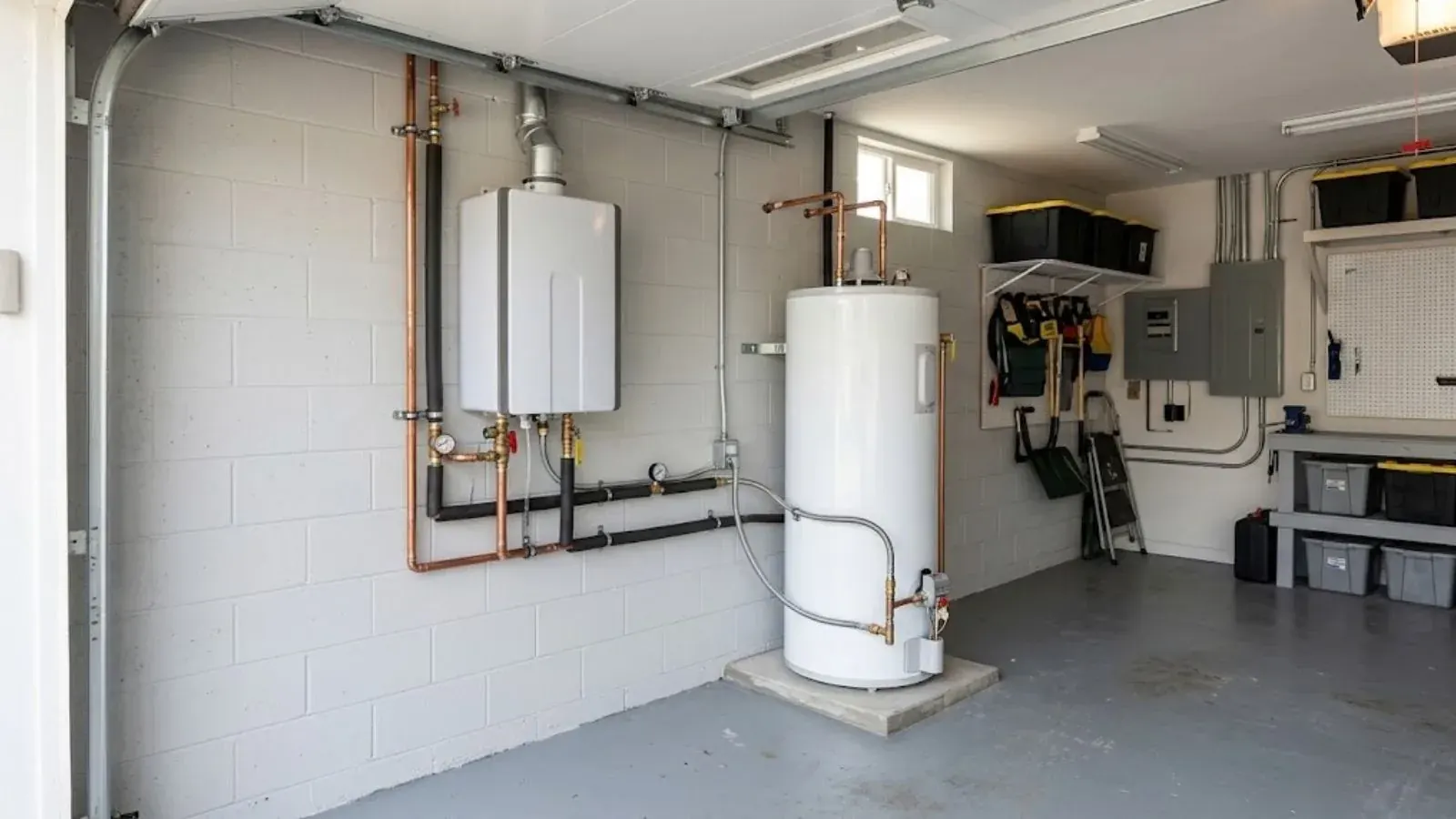
What to Set Your Tankless Water Heater To
For most Wasco households, 120 degrees Fahrenheit is the right place to start. Raise it only if you have a clear reason, and lower it if anyone in the house is young, elderly or sensitive to heat.
Start at 120 degrees and adjust from there
The U.S. Department of Energy says most households only need the water heater set at 120 degrees Fahrenheit. That applies to tankless units as well as tanks. At that setting the water is hot enough for showers, sinks and many dishwashers, and it is easier on the unit than a higher target.
Tankless heaters heat water as it flows, so the temperature you set is the temperature the unit aims to deliver at the tap. If the shower still feels too cool, the cause is often flow, distance or a limited unit, not the setpoint. The sections below show how to tell.
Matching the setting to your situation
Use this as a decision guide before you touch the dial or the remote controller.
| Situation | Suggested approach | Reason |
|---|---|---|
| Typical family household | Start at 120 | The DOE baseline covers most homes |
| Young children, older adults or anyone with sensitive skin | Stay at 120 or go a little lower | Hotter water scalds faster than people expect |
| Shower runs lukewarm even at full hot | Check flow and mixing first | Setpoint often is not the limit |
| Dishwasher or laundry labels call for hotter water | Read the appliance guide | Many have an internal heater and do not need the water heater turned up |
| Long pipe run to a far bathroom | Wait for hot water to arrive before changing the setting | Distance, not temperature, causes the delay |
Keep a note of every change you make. If something goes wrong later, a plumber can use that record.
Setting is right, water still cool?
Call the number on this page. We send a licensed plumber who can look at flow, scale and venting.
How to change the setting without guessing
Controls differ between brands, so follow the manual for your model. The sequence below applies to most units.
- Find the controllerMany units have a wall-mounted remote near the heater or in a hallway. Some keep the control on the unit itself. If neither shows a temperature display, the setting may be fixed by a dip switch or by the installer.
- Note the current settingWrite it down. Then run a hot tap for a minute and feel the water at the sink with your hand under a stream, not directly on the faucet.
- Change by one stepMove the setpoint a single step and test again after a minute of flow. Small changes make it easier to see what actually helped.
- Test at the farthest fixtureThe tap farthest from the unit tells you more than the one beside it. If only that tap is cool, the issue is travel time in the pipe.
- Look for error codesIf the display shows a code or the unit shuts down, stop adjusting. Codes usually point to flow, venting, gas supply or scale, and each of those needs a technician.
Why a hotter setpoint is not a free upgrade
A higher target means the unit works harder on every call for hot water. It also raises the scald risk, because water at the tap arrives hotter than many people expect. Most households do better with 120 and a mixing valve on the shower than with a high setting and constant tap adjustments.
Heat also tends to speed up mineral scale inside the heat exchanger. Scale is the most common reason a tankless heater loses output over time, and it is the reason tankless water heater service often includes a flush. The DOE says tankless units last about 20 years, and keeping scale under control is a large part of getting there.
Signs the problem is not the temperature setting
People often raise the setting and still get cool water. These are the usual culprits.
- A short burst of cold between two hot flows. This happens when the tap is closed and reopened quickly. The heater shuts off between uses, and a slug of cold water passes through before it fires again.
- Hot water that fades when two fixtures run. Every tankless unit has a flow limit. Running a shower and a dishwasher together can exceed what it can heat at the target temperature.
- Hot water that slowly gets worse over months. Scale in the heat exchanger or a clogged inlet filter reduces output. The unit may need a descaling flush.
- Sudden loss of heat with no code. Check that the gas supply, power and vent are intact, and call a plumber if anything looks wrong. Gas-fired units burn fuel, so leave the area and call SoCalGas or 911 if you smell gas.
If you are shopping for a new unit rather than adjusting an existing one, our page on water heater installation covers sizing, venting and the routing choices that affect how a tankless heater performs.
Wasco note: test your water before you chase a hotter setting
The City of Wasco's 2022 water quality report lists groundwater from six active wells but does not report hardness. Nearby towns publish different numbers, so you cannot borrow a neighbor's result without checking.
A hardness test strip or a lab test at your own tap tells you how aggressively scale may build in a tankless unit. If hardness turns out to be high, a water softener can protect the heat exchanger, and the right flush schedule matters more than the setpoint.
When the setting is right and the water is still wrong
A properly set tankless unit that still delivers lukewarm water needs a technician to look at flow, gas pressure, venting or scale. According to CSLB, the C-36 plumbing classification covers installing equipment that heats water, so check the technician's license at cslb.ca.gov. We can arrange that day or night, and we dispatch to Shafter and McFarland as well as Wasco.
The reported water around Wasco varies. Shafter's recent city reports show average hardness of 92 ppm in 2025, with individual wells ranging from 17 to 207 ppm. McFarland's 2025 city report shows soft water at 11 ppm. Those numbers show why two nearby homes can have very different scale problems, and why testing at your own tap is more reliable than guessing.
Cold January nights also matter if the unit sits in a garage or on an outside wall. Bakersfield, the nearest NWS climate station, has an average January low of 40.5 degrees Fahrenheit, and freezing nights are possible. Check what your manual says about freeze protection before winter.
Tankless temperature questions
For most households, yes. The Department of Energy says most households only need 120 degrees Fahrenheit. If you have a specific need for hotter water, change it in small steps and keep an eye on the scald risk.
A tankless unit has a maximum flow it can heat at the target temperature. When two fixtures draw at once, the heater cannot keep up and the water cools. Staggering use or sizing a larger unit are the usual answers.
Raising the setpoint does not fix cold weather problems, and the scale and scald risks go up. Check insulation on exposed pipes and the unit's freeze protection first.
Not directly, but scale lowers the heat output over time, which can feel like a setting problem. Test your water at the tap, and ask a plumber about flush intervals if the test shows high hardness.
Often yes, using the remote or the control panel. Some installers lock the setting, and some units have a maximum fixed by a switch. Check the manual, and call us if the display shows an error code.
Hot water on a sensible setting
Our 24/7 line takes tankless calls at any hour. Ask for a same-day appointment when available and a clear price before work starts.