How to Use Your Water Meter to Find a Hidden Leak
To find a hidden leak with your water meter, turn off every tap and appliance, read the meter, wait two hours with no water used, and read it again. If the reading changed, you probably have a leak.
A second step, closing the house shutoff and watching the meter once more, tells you whether the leak is inside the house or in the buried line.
The test in plain terms
The EPA's advice is simple: read the meter, use no water for two hours, then read it again. Leaks hide because water from a toilet flapper, a buried line or a slab does not show up on the floor. The meter does not care where the water goes, only that it is moving.
The stakes are real. The EPA says the average household's leaks can waste more than 9,300 gallons of water every year. A small continuous leak is quiet, and the first sign is often the bill.
Run the test in seven steps
Pick a time when nobody will be home or asleep. An evening or a night works, so water use is easy to avoid.
- Shut off everything that uses waterClose taps, stop the dishwasher and washing machine, and switch off any ice maker or humidifier. Check that no one flushes during the test.
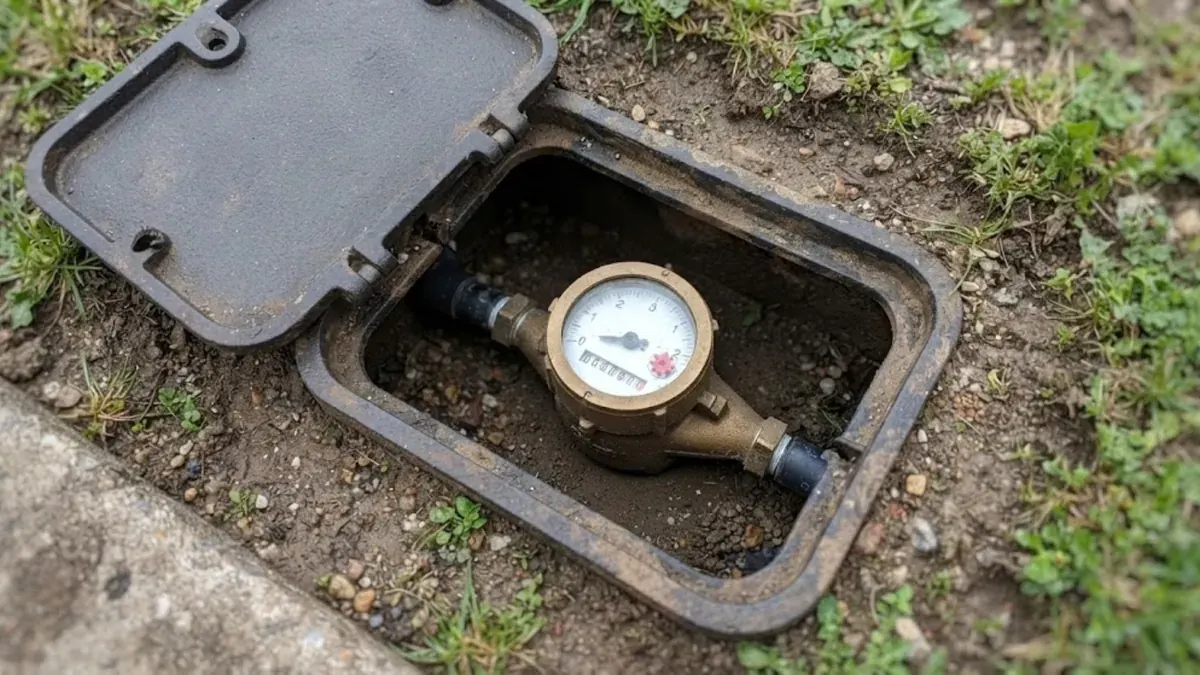
- Find the meterIt usually sits under a lid in the ground near the street or property line. Lift the lid carefully and look for spiders or debris before reaching in.
- Look at the small dialUC Master Gardeners say the smaller blue dial moves when water is flowing. With all water off, it should hold still. If it is turning, you can already suspect a leak.
- Write down the full readingNote every digit, or take a photo. You will compare it to the later reading.
- Wait two hours without using any waterDo not flush the toilet, run a tap or let the sprinklers start. Even one flush ruins the test.
- Read it againIf the number has gone up, water is leaving the system somewhere. If it is identical, you probably do not have a continuous leak.
- Narrow it with the house shutoffClose the main shutoff valve at the house, wait a few minutes, then watch the meter dial. We cover what the result means below.
Ran the test and the meter moved?
Call the number on this page and say whether the dial stopped when the house shutoff closed. A licensed plumber can scope the visit by phone.
What your meter result means
Two readings, taken together, point to where the leak is.
| Meter test result | Where the leak likely is | Who to call |
|---|---|---|
| Meter moves with all water off, and stops when the house shutoff is closed | Inside the house: a fixture, pipe or slab | Leak detection plumber |
| Meter keeps moving even with the house shutoff closed | Buried line between the meter and the house, or the shutoff itself | Service line repair |
| Meter does not move, but the bill is high | Heavy use, irrigation, or a leak that only runs at certain times | Check bills and sprinkler timers |
| Meter moves only slightly, then stops | A toilet flapper or a slow drip | Test the toilets first |
If the meter does not move during your test, a leak can still exist, since some leaks only run when a pump or timer starts. A plumber can test the system under pressure and listen to the pipes.
Rule out the easy leaks first
The EPA lists worn toilet flappers, dripping faucets and other leaking valves as the most common sources of household leaks. Toilets are the first suspect. Drop a little food coloring in the tank and wait. If color reaches the bowl without flushing, the flapper is leaking, and a toilet repair is usually quick.
Check faucets and hose bibs for drips, and walk the yard if you have sprinklers. A single stuck irrigation valve can run for days without anyone noticing. A dripping tap is a small fix, and our faucet repair page covers what that visit involves.
When the meter moves and nothing inside is running
If you closed the house shutoff and the meter kept turning, the water is escaping before it reaches your home. That points to the service line that carries water from the meter to the house, or to the shutoff valve itself.
If the meter stopped when the shutoff closed, the leak is inside your plumbing. A warm spot on the floor, a musty smell, or a hiss from a wall may narrow it down. On a slab foundation, a hidden pipe leak can also run under the concrete, and our slab leak repair page explains how those are located.
Do not dig to chase a buried line. Call 811 first so utilities are marked, and have a licensed plumber confirm the location before any digging begins.
Wasco's water rules and the meter
The City of Wasco's water conservation chapter requires leaks to be fixed, and it treats 48 hours after discovery as a reasonable time to do so. A meter that proves you have a leak therefore starts a clock, so get the repair booked soon rather than letting it run.
The city's water comes from groundwater wells, with about 94 miles of distribution lines according to its 2022 water quality report. If you suspect a problem on the utility side, such as damage at the meter box itself, tell the City of Wasco's water utility rather than digging on your own.
Keep your two meter readings and the time between them. They are useful when you talk to the utility or the plumber.
Getting help after the test
Once the test shows a leak, stop guessing and have it located. A plumber can use acoustic tools that listen for leak noise, thermal tools that show temperature differences, and pressure tests to pinpoint the spot without tearing out a wall.
We also dispatch to homes in Shafter and McFarland. Same-day appointments are offered when available. If water is spraying or pooling, close the main valve and call the 24/7 emergency line right away.
Meter test questions
Two hours with no water used is the EPA's suggested interval. A longer wait, such as overnight, can catch very small leaks, as long as nobody uses water in between.
Probably. The most common cause is a toilet flapper that does not seal, which lets water trickle into the bowl without anyone noticing. Test the toilets before assuming a buried leak.
If the meter keeps moving after the toilets are ruled out, move on to the house shutoff test.
Some leaks only run at certain times, such as a sprinkler timer or a pump that cycles. Others come from higher use, a long irrigation run or visitors. Compare your bill dates to your usage, and run the test again during the time the high use seems to happen.
The city's water conservation chapter requires leaks to be repaired and presumes 48 hours after discovery to be a reasonable time. Fixing a leak sooner also stops the bill from climbing.
If you rent, tell the property owner in writing as soon as the test shows a leak.
Yes, but switch off auto-fill, regeneration cycles and any irrigation first, since those can move the meter on their own. If you cannot stop them, note their schedule and test in a window when they are idle.
Find the leak before the next bill
If the meter test shows water going somewhere, call the 24/7 emergency line. We offer same-day appointments when available, with a clear price before work starts.