Emergency Leak Detection in Wasco, CA
A water meter that keeps turning with every tap closed, a bill that climbed for no clear reason, or a stain spreading across a ceiling all mean water is escaping somewhere you cannot see.
Our line connects you with a licensed plumber who finds the exact spot first, so the repair opens as little of your home as possible.
Water is leaking and you can't see where
If water is coming through a ceiling, pooling at the base of a wall, or the meter is spinning with everything off, treat it as an emergency. Our line is answered 24/7, and we send a licensed plumber the same day when one is available, nights and weekends included. While you wait, close the main shutoff and stop using water.
Leak detection in Wasco, CA is the work of finding where pressurized water is escaping from a supply line, and how far the damage has spread, before anyone cuts into drywall or breaks concrete. A plumber starts from the symptoms and narrows toward a measured location. The goal is one small, well-placed opening instead of several guesses.
Active leak: what to do first
These steps limit damage while the plumber is on the way. None of them requires tools.
Before the plumber arrives
- Close the main valve. Turn the home's main shutoff clockwise until it stops. Open one low faucet to drain what is left in the pipes.
- Watch the meter once. With the main closed, look at the meter. If it still turns, the leak sits on the street side of your valve, and that detail helps the plumber.
- Cut power near the water. If water is dripping from a light fixture, fan or ceiling outlet, switch off that circuit at the panel. Do not stand in water to reach it.
- Keep out from under a sagging ceiling. Drywall holding water can drop without warning. Move people, pets and furniture away from the bulge.
- Photograph the damage. Pictures of the stain, the meter and the wet area help with the plumber's notes and with any insurance claim.
Meter still running after the test?
Call the 24/7 line and describe the dial, the stain or the warm spot. We send a licensed plumber the same day when one is available.
Signs the leak is hidden, not just a dripping faucet
Callers describe hidden leaks in everyday terms. These are the ones that most often turn out to be real.
- The meter moves when nothing is on. Every tap, appliance and ice maker is idle and the dial still creeps. This is the clearest sign.
- The bill jumped. Your habits did not change, but the usage line did. A slow leak often shows up here first.
- A warm patch on the floor. A spot that feels warm underfoot, or a water heater that runs far more than before, can mean a hot line is leaking nearby.
- A wet wall or a ceiling stain. Bubbling paint, soft drywall or a brown ring that grows after a shower or after the dishwasher runs.
- Pressure that dropped on its own. Weak flow at every fixture, with no change at the street, can be water leaving the pipe before it reaches you.
- Running or hissing sounds at night. In a quiet house, a faint rush near a wall or the floor points to pressurized water escaping.
One symptom is a hint. Two together, such as a running meter plus a damp wall, usually mean a pressurized line has opened up.
Use your water meter to confirm the leak
The EPA recommends reading your meter before and after a two-hour period when no water is being used. If the reading changes, you probably have a leak. Here is how to run that test cleanly.
- Stop every source of waterClose faucets, pause the dishwasher and washing machine, and ask everyone at home not to flush. Check that the sprinkler timer is not due to run.
- Read the meterLift the lid carefully, since the box can hold debris. Write down the digits. Also note the small dial, which the UC Master Gardener program says should stand still when all water is off.
- Wait two hoursStay out of the water the whole time. Leave a note on the bathroom door if others are home.
- Read it againA different number, or a dial that moved, means water is leaving the system somewhere.
- Close the main and test once moreIf the meter stops when your main valve is closed, the leak is on the house side. If it keeps turning, look between the meter and your valve.
What a high bill and the EPA numbers actually mean
The EPA says the average household's leaks can waste more than 9,300 gallons of water every year, and that nine percent of homes have leaks wasting 50 gallons or more per day. The most common culprits it lists are worn toilet flappers, dripping faucets and leaking valves. Check those simple fixes first, because a failed flapper can look exactly like a hidden pipe leak on a meter.
Compare your bill with the same month last year, not with last month. The nearest NWS climate station, Bakersfield, averages a July high of 98.3 F, so yards and gardens pull far more water in summer and a bigger bill then is not proof of a leak. A jump that stays after irrigation is shut off, or one that appears in a cool month, deserves the meter test.
Once a leak is confirmed, do not let it sit. The City of Wasco's water conservation chapter requires leaks to be fixed and presumes 48 hours after discovery is a reasonable time to do so. Confirm current wording with the city, and book the work soon after a failed meter test.
Where a leak hides and how it gets located
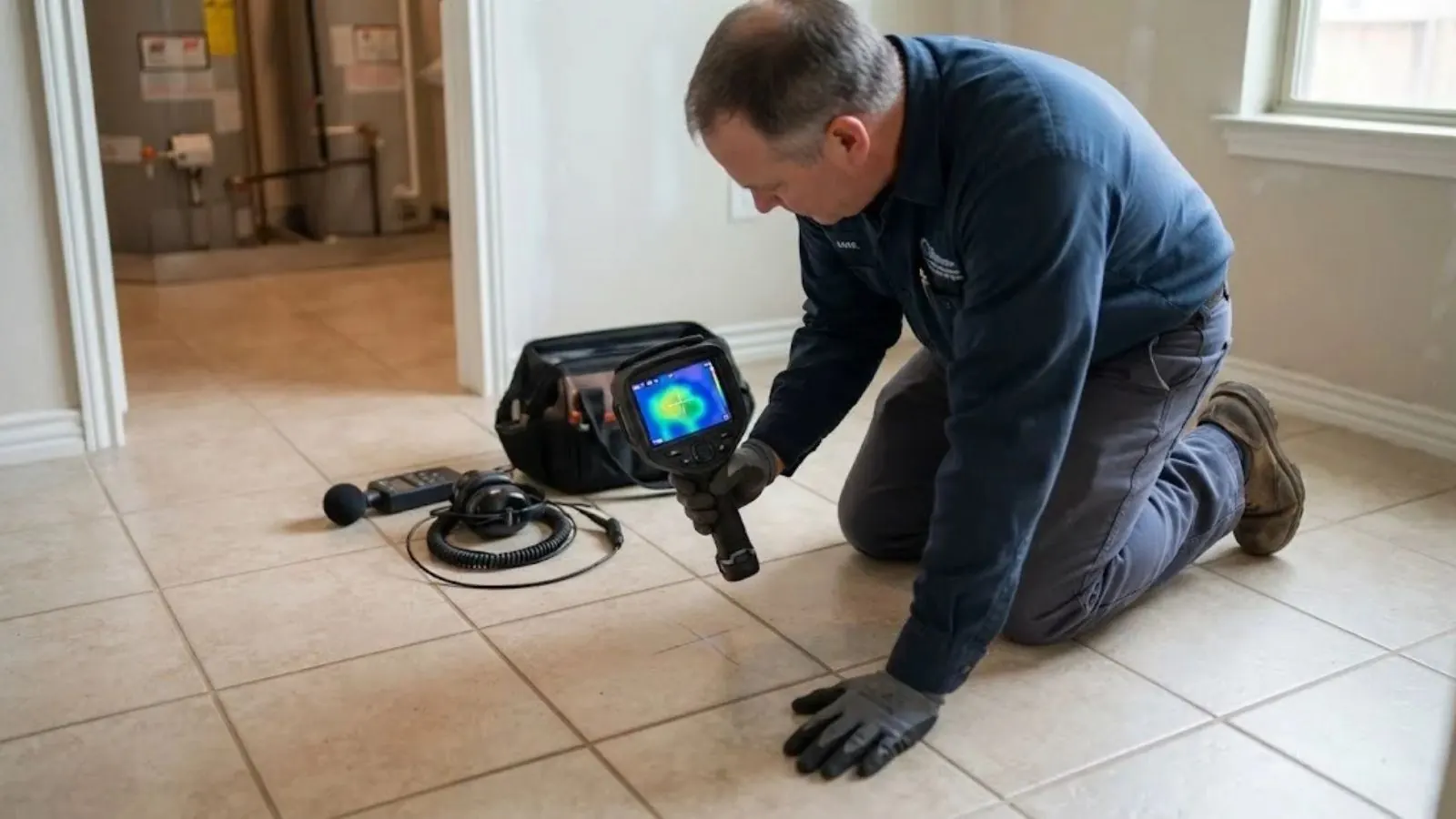
Different hiding places call for different methods. Plumbers generally combine two methods and confirm the spot before opening anything.
| Where it hides | What you notice | How it is usually located |
|---|---|---|
| Inside a wall or ceiling | Stain, soft drywall, sound of water | Moisture readings and thermal imaging map the wet area, then acoustic listening finds the pipe |
| Under a floor or slab | Warm spot, meter running, low pressure | Acoustic listening and pipe tracing, then a pressure test of isolated sections |
| Buried line to the house | Wet ground, lush strip of grass, meter running | Pressure test, acoustic correlation between two points, tracer gas where it suits |
| Irrigation system | Soggy turf, weak sprinkler heads | Zone-by-zone isolation to find which valve or line is losing water |
| Meter box or shutoff area | Water standing in the box | Visual check of the valve, fittings and meter connection |
Acoustic correlation compares leak noise at two points on a pipe. Tracer gas is injected into an emptied line and a detector finds where it escapes. Both are standard approaches, and which one fits depends on the pipe material and the surface above it.
A stain on the ceiling or a damp wall
Water travels along framing and drywall before it shows itself, so the stain is rarely right under the leak. A plumber traces upward and sideways, running fixtures one at a time to see which one makes the stain grow. A bathroom above a ceiling stain is the usual first suspect, and the question is whether the water comes from a supply line, a drain or the shower pan.
Supply lines are tested by isolating a section and watching a gauge. Drain leaks only show up while water is flowing. If the line itself has split, the repair becomes burst or cracked pipe repair, which is done through a small access opening followed by a drywall patch.
Under the house, in the crawl space or beneath the slab
Depending on how your home was built, pipes may run through an attic, a crawl space, inside walls or beneath a concrete slab. We do not assume which one you have until the plumber looks. A meter that runs while the walls and ceilings stay dry often points to a line you cannot see, and the next step is tracing where it goes.
When the evidence points to pipes in or under concrete, the job moves to slab leak repair, where rerouting the line is often an alternative to breaking the floor. A warm patch on a hard floor is the signal to mention on the call.
Buried supply lines, yards and private wells
The pipe from the meter to the house is buried, so its leaks surface as a wet patch, a sunken strip of ground or a meter that runs with the house shut off. That section is covered under water service line repair. Call 811 before anyone digs to explore, because buried utilities cross yards and SoCalGas serves Wasco.
If your property runs on a private well instead of city water, a pump that never stops cycling can mean a leak between the pump and the house, or a well problem. The State Water Board classifies the Kern County Subbasin as critically overdrafted and notes that falling groundwater levels can make shallow wells go dry. A plumber can pressure-test the pipe on the house side, and a well contractor handles the well itself.
Sprinklers, drip lines and the meter box
Irrigation leaks are common because the lines are shallow and valves stick open. A zone that stays soggy a day after it runs, or sprinkler heads that spray weakly, narrows the search to one valve or one run of pipe. Isolating each zone shows which one is losing water without digging the whole yard.
Water standing in the meter box is usually a fitting at the meter or the shutoff. It looks minor, yet it can run all day.
Pools, spas and businesses
Evaporation explains many pool water drops. A plumber can test the house supply, the fill line and the equipment plumbing, but the shell or liner of the pool itself is a pool specialist's job. Businesses with a running meter can use the same line, and the approach is the same for commercial properties.
What shapes the price of finding and fixing a leak
Detection pricing depends on the job, not a flat rate. Here is what moves it.
Homeowners policies treat sudden damage and long-term seepage differently, so ask your insurer what counts and what documentation they want.
Every job starts with a clear price before work begins. For your real number, call the number on this page and describe the symptom.
Leak detection questions from Wasco homeowners
Yes. The line is open 24/7, and we send a licensed plumber the same day when one is available. A running meter, a ceiling that bulges or water near electrical fixtures are the situations to call about right away.
Close your main valve first. That stops most damage and does not make the detection harder.
Probably. A slow creep on the small dial means water is leaving the pipes, and slow leaks can run for months before a stain appears. Rule out a toilet flapper first, then run the two-hour test.
If the dial still moves after the toilets are ruled out, it is worth locating the source.
Often the location can be narrowed to a small area without opening anything, using moisture readings, thermal imaging and listening tools. A small access hole is usually still needed to confirm the pipe and make the repair.
The aim is to open the smallest patch of wall or floor that reaches the damaged pipe.
Leak detection mostly targets pressurized supply lines. Drain and sewer problems show up differently and are checked with a camera. If the signs point there, a sewer inspection is the better tool.
Ask the City of Wasco water department where its responsibility ends, because the meter and the connection to the main are on the utility side. California's plumbing license classification covers water piping from the property owner's side of the meter to the structure, which is where a plumber works.
A plumber can confirm which side of the meter the leak is on before you make that call.
The owner or manager should call, ideally with the tenant on site to give access. Share the meter reading and the room where the symptom shows, so the plumber starts in the right place.
For a multi-unit property, note which unit and which meter or sub-meter is moving.
Find it once, fix it once
A confirmed leak location keeps the repair small and the bill clear. Call the number on this page any hour and we will get a plumber on the way.