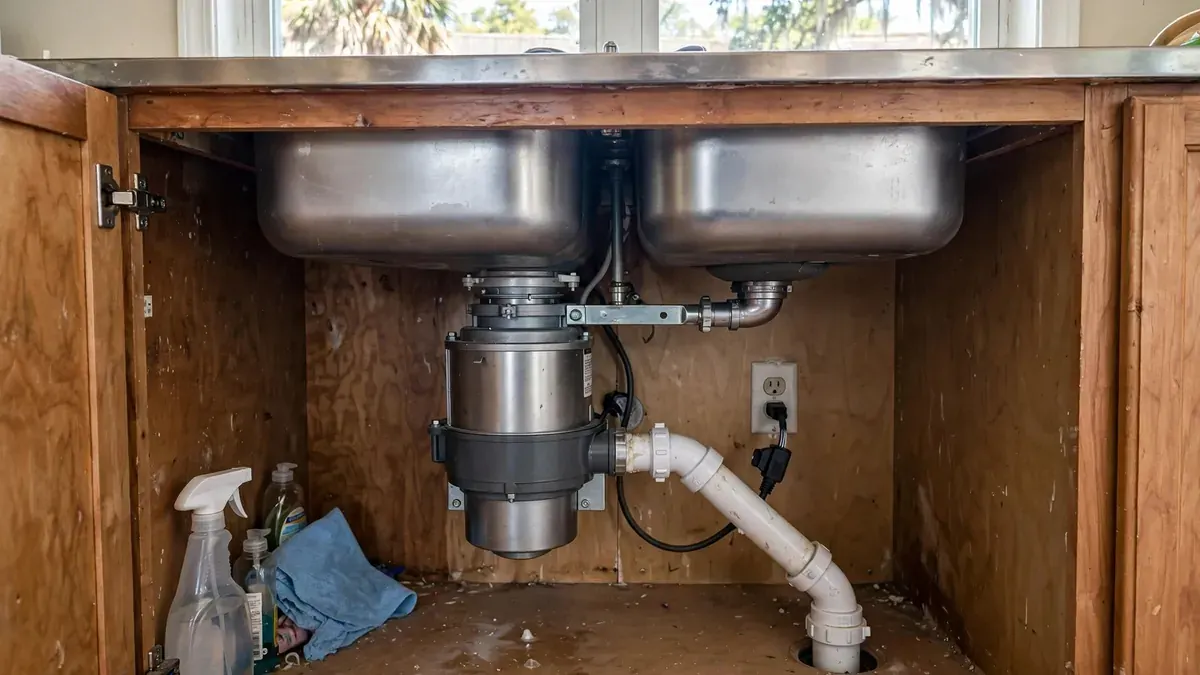
How a Double Kitchen Sink With a Disposal Is Plumbed
A double kitchen sink with a garbage disposal drains through one shared trap. The disposal sits under one basin, and its outlet joins the second basin's drain through a waste tee before everything flows into a single trap and out to the wall.
The details below show each part, the order of assembly, and where the dishwasher fits in.
Think of the setup as three short pipe runs that merge. The disposal outlet runs sideways, the second basin drops straight down from its strainer, and both meet at a tee. From the tee a single tailpiece drops to the trap, and the trap arm carries the water into the wall.
Sharing one trap is normal. Two traps in a row on the same drain, sometimes called double trapping, can make a sink gurgle and drain slowly. If you find that arrangement under your sink, it is worth having someone look at it.
Every part under the sink and what it does
Pull the cabinet contents out and compare. Most double-sink setups use the same handful of parts.
| Part | Job | Common failure |
|---|---|---|
| Basin strainer and flange (basin 2) | Catches food and seals the sink to the drain pipe | Dried putty or a loose nut drips at the rim |
| Disposal mount (basin 1) | Holds the disposal under the sink and seals the flange | Loose mounting ring leaks into the cabinet |
| Disposal outlet and elbow or flange | Sends ground waste out sideways | Cracked gasket or a loose bolt |
| Waste tee or continuous waste | Joins the two basin drains into one line | Slip nut gaskets that weep |
| Trap | Holds a water seal that blocks sewer gas | Grease clogs and corroded fittings |
| Trap arm and wall stub | Carries the water to the drain in the wall | Slow flow if the arm is level or sags |
| Dishwasher inlet on disposal | Receives the dishwasher drain hose | A plug left in place blocks the dishwasher drain |
Leaks nearly always occur at the slip nuts and gaskets, so you can start the search there.
Leaking under the sink right now?
Close the supply valves, then call the number on this page. We answer 24/7 and offer same-day appointments when available.
Follow the water: how the drain path goes together
Install order matters, since the pieces nest into each other. Work from the sink down.
- Set the strainersSeat the flange on basin 2 with putty or a gasket and tighten it from below. On basin 1, the disposal mount takes the place of a standard strainer.
- Hang the disposalLift it onto the mounting ring and lock it in place. Turn the power off at the breaker first, and confirm the disposal is dead before touching the wiring.
- Connect the two drainsRun the disposal outlet to the tee and the basin 2 tailpiece to the same tee. Point the disposal side slightly downward so water does not pool.
- Drop to the trapAttach one tailpiece below the tee, then the trap, then the trap arm to the wall stub. The trap arm should slope toward the wall, since the plumbing code's general rule for horizontal drain pipes is a fall of at least 1/4 inch per foot.
- Add the dishwasher drainRemove the knockout plug in the disposal inlet, then clamp the drain hose to it. Forgetting the plug is a classic reason a new dishwasher will not drain.
- Test for leaksFill both basins, release them, and run the disposal. Dry each joint with a paper towel and check again after a few minutes.
Dishwasher drain: high loop or air gap
The dishwasher hose should rise to the underside of the counter before it drops to the disposal inlet, forming a high loop. This keeps sink water from running back into the dishwasher. Some homes use an air gap fitting on the counter instead, so follow whichever your installation already has.
Why the second basin drains slowly
A common complaint on double sinks is that one basin drains fine while the other lags. When the disposal side is slower, grease buildup in the tee or trap is the usual cause. When the plain basin is slower, the tee may be installed with too little downward slope.
A plumber clears the trap first and then checks that the trap arm falls toward the wall. If the line behind the wall is partly clogged, drain cleaning with a cable clears it from the cleanout or the trap opening. Routine care, such as running cold water while the disposal works, keeps grease moving down the line.
Shopping list for a new double-sink drain
Take a photo of your current setup and bring this list to the store.
- Waste tee or continuous waste kit Matched to the pipe size under your sink, which is usually printed on the old fittings.
- Trap and trap arm Choose the same material as the rest of the drain, so the connectors seal cleanly.
- Slip-joint washers A fresh set of gaskets for every connection is the best protection against leaks.
- Plumber's putty or gasket For the basin 2 flange, depending on the strainer you buy.
- Dishwasher drain hose clamp Needed when a new dishwasher is hooked up to the disposal.
- A bucket and rags Old traps hold dirty water, and you will spill some.
Wasco note: check which plumbing code your permit follows
The state's 2025 California Plumbing Code took effect January 1, 2026, but the City of Wasco's municipal code still names the 2022 edition when it adopts the plumbing code by reference. The city may update that, so confirm which edition applies before you start.
The City of Wasco directory lists Community Development and Planning but no separate building department, and the city website links to an online permit portal. Call the city to ask whether swapping a sink drain needs a permit, and whether moving the sink location changes the answer. Our dispatch also covers Shafter and McFarland, and those cities run their own permit desks.
When to hire it out
Swapping a tee and trap is a manageable weekend task. Moving the sink, adding a second disposal or opening a wall to change the drain slope is not. California requires a contractor license for work worth one thousand dollars or more in labor and materials, so check any plumber at cslb.ca.gov.
If your disposal hums but does not spin, or leaks from its body, garbage disposal repair is the fastest route. For a remodel that moves the sink, plumbing installation covers the new drain and supply lines.
Questions about double sinks and disposals
No. A double sink with a disposal normally uses one trap shared by both basins. The tee joins the two drains before the trap.
Two traps in a row on one drain line is a layout worth having a plumber check, since it can cause slow draining and gurgling.
Either side works, but many homeowners pick the basin closest to the dishwasher so the hose stays short. Make sure the disposal outlet lines up with the tee height.
If the tee is too low, the disposal may drain poorly.
Either the hose does not have a high loop or the disposal inlet is partly clogged with food. Clear the inlet and make sure the hose rises to the underside of the counter.
Check also that the knockout plug was removed from the disposal inlet.
The City of Wasco code adopts the 2022 California Plumbing Code, while the state's 2025 edition took effect January 1, 2026. Ask the city which edition it applies to your job.
For anything beyond a like-for-like swap, ask before you start.
Yes. If both basins and other fixtures drain slowly, the problem lies beyond the sink trap. A drain cable or a camera inspection can find it.
If the kitchen sink backs up into the other sink, stop using water and call the 24/7 line.
Get the drain built right
Call the number on this page and a licensed plumber can handle the tee, trap and disposal hookup. You will get a clear price before work starts.