Emergency Garbage Disposal Repair in Wasco, CA
A disposal that hums and will not spin, drips into the cabinet, or leaves the sink full of gray water usually has a specific, fixable cause.
We dispatch licensed plumbers across Wasco to clear, repair, replace or install garbage disposals and to sort out the plumbing around them.
The sink is backed up, the disposal hums, or water is under the cabinet
If the kitchen sink is full or the cabinet floor is wet, stop running water, switch the disposal off, and call the 24/7 emergency line. A licensed plumber can be dispatched at any hour, and same-day appointments are offered when available. Never reach into the drain with your hand, even when the unit is off.
A garbage disposal is a grinder that sits below the sink and feeds into the drain trap. When it fails, the symptom tells you a lot. A hum with no spin means a jam. Dripping means a seal or a connection. A dead unit with no hum often means a tripped overload or an electrical fault.
Our dispatcher asks what you see, where the water is, and whether anything solid went down the drain, so the plumber arrives with a plan.
Power off before you touch anything
A disposal contains blades and a motor. The wall switch is not enough to make it safe.
Make it safe first
- Unplug it or cut the breaker. Most disposals plug in under the sink. If yours is hardwired, switch off the breaker that feeds it, and leave a note on the panel so nobody turns it back on.
- Stop adding water. Do not run the tap or the dishwasher if the sink is full, since both drain through the same trap.
- Keep hands out of the hopper. Use tongs or long pliers to lift out anything you can see. Do not use a hand, a spoon or a screwdriver.
- Skip chemical drain cleaners. They sit in the disposal, splash back, and can harm seals and the plumber who opens the trap later.
- Mop the cabinet and watch the dripping spot. Put a dry paper towel under each connection. Where it gets wet first tells the plumber where to look.
Cabinet wet or sink full?
Unplug the disposal, stop using the sink, and call the 24/7 line. We can send a licensed plumber the same day when available.
Freeing a jam: hex key and reset button
Do these only with power confirmed off, and check your unit's manual first. If anything feels wrong, stop and call.
- Look into the hopper with a flashlightRemove visible objects with tongs, such as a bottle cap, a fruit pit or a piece of silverware.
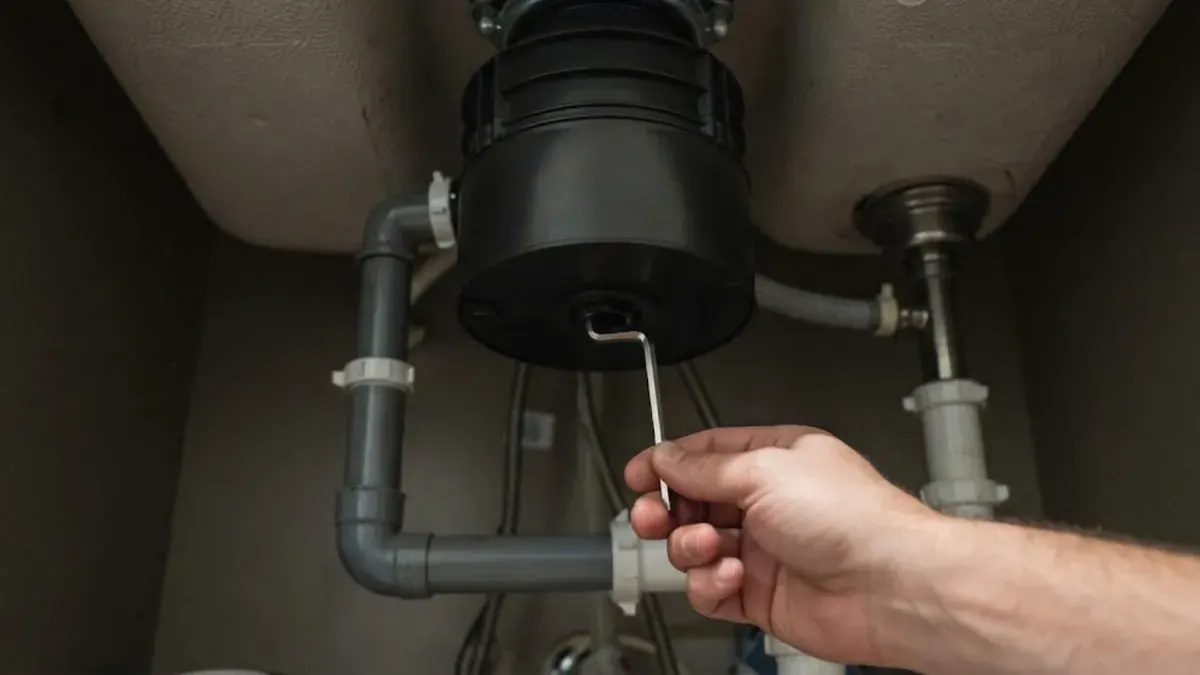
- Find the hex socket underneathMost disposals have a socket in the center of the bottom. Insert the hex key that came with the unit, or a matching wrench.
- Work the key back and forthTurn it in both directions until the motor shaft moves freely. Do not force it past a hard stop.
- Press the red reset buttonIt is on the bottom of the housing. It pops out when the motor overheats or overloads, and it needs a few minutes to cool.
- Restore power, run cold water, testPlug it back in or reset the breaker, run cold water, and switch it on for a few seconds. If it hums again, shut it off and call.
Where the water shows up and what that means
| Wet spot | Likely source | Fix |
|---|---|---|
| Rim of the sink flange at the top | Mounting seal or putty failed | Reseat the flange, new gasket |
| Seam at the side of the disposal body | Internal seal or housing crack | Replace the disposal |
| Discharge elbow where it meets the trap | Loose or damaged gasket | Tighten, replace the gasket or elbow |
| Dishwasher hose at the disposal inlet | Loose clamp or split hose | Reclamp or replace the hose |
| Drain trap joint | Slip nut worn, trap corroded | Rework or replace the trap |
| Cabinet wet but no clear drip | Slow leak from several points | Dry everything, then trace with the unit running |
A leak from the disposal body is almost always the end of that unit. Leaks at connections are often a quick fix.
Leaks from the body versus the connections
To separate the two, dry everything and run a measured amount of water with the unit off while watching the underside. If the drip appears at the grind chamber seam or the base, the housing has failed and replacement is the right answer.
If the water appears at the flange, the dishwasher hose or the elbow, the disposal may be fine. Those parts cost far less to replace than the unit, and a plumber can show you the exact spot before anything is changed.
Humming, grinding, and a drain that stays slow
A hum without motion is a jam or a seized motor. A grinding noise with spinning may be a spoon or a pit still inside, or worn bearings in an old unit. A disposal that spins but drains slowly often has a clog in the line past it, not in the unit.
If the other fixtures gurgle or the sink backs up even with the disposal off, the blockage is further down and drain cleaning is the call.
Under Wasco city code, the sewer lateral from 12 inches outside the building to the city main is the owner's responsibility. A backup in that stretch is yours to repair, and sewer line cleaning covers the line that carries it.
The dishwasher connection
The dishwasher drain hose connects to a nipple on the disposal, and a knockout plug in that nipple must be removed on a new unit or the dishwasher will not drain. If you replaced the disposal and the dishwasher now holds water, that plug is a common reason.
Dishwasher drains need either a high loop under the counter or an air gap to keep dirty water from flowing back. The right arrangement depends on the fixtures and local code, so ask the City of Wasco before you change it.
Double sinks and how the drain is piped
On a double bowl sink, the disposal normally sits under one bowl and a short pipe carries the second bowl's water across to the same trap. Everything meets at one trap before the wall.
Problems come from too little slope in the crossover, a trap installed too low, or a disposal outlet that sits above the trap arm. Those layout faults cause standing water and slow drains, and they are fixed by reworking the pipes, not by running a snake. If you want to add a disposal where none exists, that is a small job under plumbing installation with a power source and a switch to plan.
What should never go down a disposal
Most calls trace to a handful of things.
- Grease, oil, fat. It cools in the trap and the line and builds a plug.
- Coffee grounds and eggshell. They pack into a paste in the trap.
- Fibrous food. Celery, corn husks, artichoke leaves and potato peels wrap around the shredder.
- Pasta, rice and bread. They swell with water and clump.
- Bones, pits and shells. Large or hard items can jam or dull the unit.
- Non-food items. Bottle caps, produce stickers and utensils drop in by accident, so check the hopper before you switch on.
Run cold water before, during and for a little while after use so the waste moves through the trap.
Repair or replace the disposal
| Condition | Better choice |
|---|---|
| Jam cleared and the motor spins | Repair or just use it |
| Hum persists after the hex key and reset | Replace |
| Leak from the body | Replace |
| Leak at the flange or dishwasher hose | Repair the connection |
| Unit is old and noisy, or needs frequent resets | Replace |
| Moving to a bigger family or heavier use | Replace with a stronger motor |
What shapes the price of a disposal job
A clearing, a gasket and a full replacement are different jobs.
A kitchen flood from a split disposal may involve your insurance, so photograph the cabinet and the unit before it is removed.
According to the Contractors State License Board, the plumbing contractor classification covers the water supply and the disposal of fluid waste. Before a disposal job that touches the drain, check the plumber's license on the board's website and confirm it covers that work.
For a number that fits your sink, call the number on this page and describe the unit and the leak.
Coverage around Wasco
We dispatch for kitchen calls throughout Wasco, and we also reach homes in Shafter and in McFarland by way of State Route 43 and State Route 46.
Disposal questions people ask on the phone
Yes. The line is open 24 hours a day, seven days a week, and a plumber can be dispatched for a flooding cabinet or a backed up sink. Same-day appointments are offered when available.
Switch the unit off at the plug or the breaker and stop using the sink until the plumber arrives.
Cut the power first, then use the hex key socket on the bottom to free the shaft and press the red reset button. If it hums again after that, the motor or the jam is beyond a quick fix and it is time to call.
No. Water near the motor and the electrical connection is a hazard. Turn it off at the plug or breaker and keep the leak contained until it is repaired.
Often yes, if there is a sink drain that fits it and a safe power source. The plumber checks the cabinet space, the electrical, and how the dishwasher will drain. Permit rules for new connections are set by the city, so ask the City of Wasco.
A new disposal usually has a knockout plug in the dishwasher inlet. If it was not removed, the drain hose has nowhere to go. A plumber can punch it out and clear the plug pieces.
Landlords and property managers can call with the address, the tenant's contact for access, and who approves the price. Ask for notes on the failed part so you have a record of the cause.
Get the kitchen sink working again
Tell the dispatcher what the disposal is doing and where it leaks. The price is agreed before work starts.