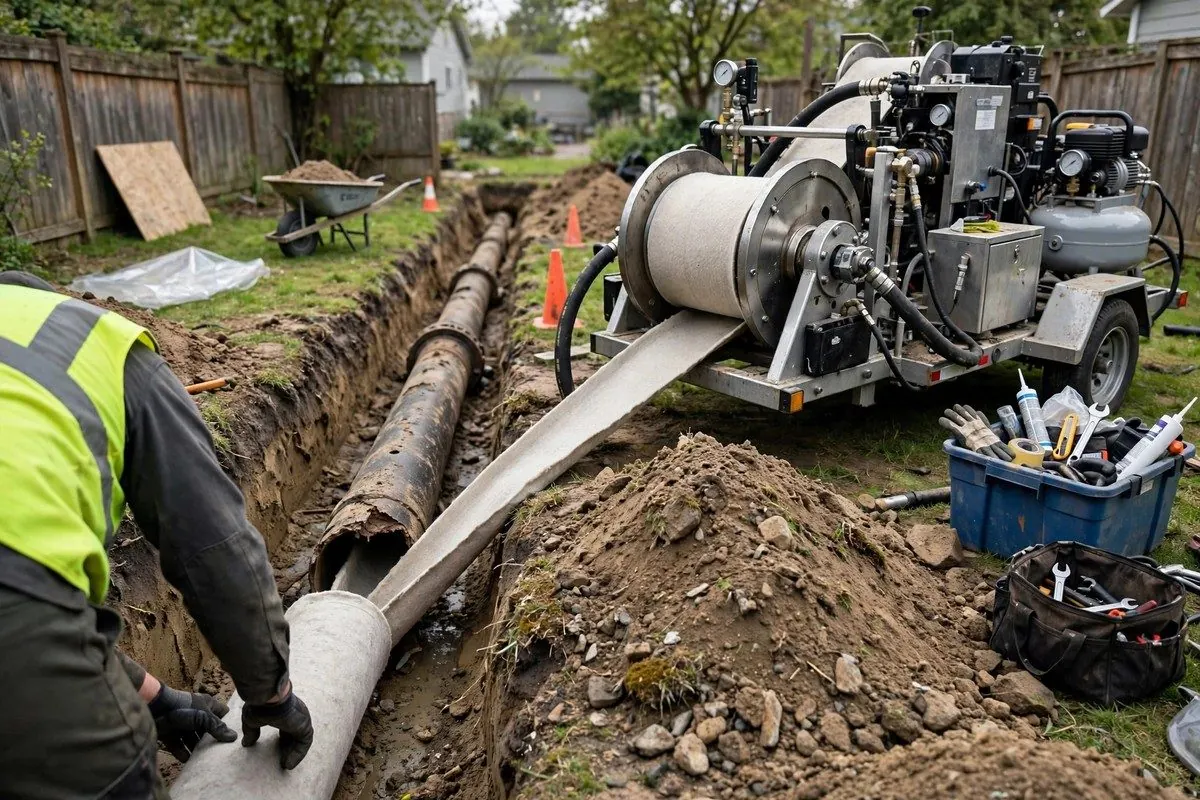
Emergency Sewer Line Repair in Wasco, CA
Sewage in the tub, a wet patch in the yard or a smell that will not go away can mean the pipe itself has failed, not just clogged.
Sewer line repair in Wasco, CA is the work of fixing a cracked, broken, shifted or root-damaged pipe between your house and the city main, by patching it, lining it or replacing it.
Sewage coming up in the house or yard
A sewer backup is not a wait-until-Monday problem. The 24/7 emergency line is answered at all hours, and a licensed plumber is sent for backups on nights and weekends in Wasco. Until the plumber is there, stop using water everywhere in the house, keep people and pets away from the wet area and stay out of standing sewage.
A backup has two possible causes, and the repair is different for each. A plain blockage is cleared and the line works again. A damaged pipe keeps failing no matter how often it is cleared. A camera run is how the plumber tells them apart.
Sewer backup: what to do first
These steps limit the mess and protect your family until the line is open.
Before the plumber is there
- Stop all water use Do not flush, shower, run the washer or the dishwasher. Wastewater has nowhere to go and will rise at the lowest drain.
- Keep children and pets away Sewage on floors and carpet carries bacteria. Keep everyone out of the wet room, and wear rubber gloves and boots if you must go in.
- Do not open the cleanout If sewage is rising in the house, uncapping the cleanout can send it across the yard. Show the plumber where it is when they come.
- Lift valuables off the floor Move boxes, rugs and electronics that can still be saved. Porous items that soak up sewage usually have to be thrown away.
- Take photos for the insurer Photograph the wet areas before anything is cleaned. Policies treat sewer backup differently, so ask yours what it covers.
Sewage backing up right now?
Call the number on this page. A licensed plumber is sent, and you can ask about the clear-out and the camera run in the same call.
Who owns the pipe under your yard
The City of Wasco's code is specific. The house connection sewer, meaning the lateral that runs from 12 inches outside the building wall to the city main, is not city property. Maintenance and repair are the property owner's responsibility, not the city's.
In practice, a failed pipe between your house and the street is your repair, even when the broken section lies under the sidewalk or the street edge. The code also requires a cleanout in every house connection sewer where it meets the soil pipe, which gives the plumber an entry for the camera. The city line begins at the main in the street, and trouble there is a call to Public Works.
Renters should tell the landlord the same day, since the owner carries the lateral. A landlord or property manager can approve repair work by phone.
Spot repair, trenchless lining or full replacement
The right repair depends on how much of the pipe is damaged, where it sits and what is above it. The camera findings drive the choice.
| Repair | Fits when | Trade-offs | Digging |
|---|---|---|---|
| Spot repair | One cracked section or a failed joint, with the rest of the pipe sound | Smallest scope, but leaves old pipe on either side | A small excavation at the damage |
| Trenchless lining (cured-in-place) | Several joints or hairline cracks along a pipe that is still round and in line | Cannot fix a collapse or a deep sag, and reduces bore slightly | Little to none, usually from the cleanout |
| Pipe bursting | A badly worn pipe that follows a straight route with room at both ends | Requires entry and exit pits, and not every site suits it | Two access pits |
| Full open-trench replacement | Collapsed, bellied, crushed or offset pipe, or a pipe with several breaks | Most disruption to landscaping and paving | A trench along the line |
The trenchless industry association NASSCO notes that these methods can repair or replace a pipe without digging it all up. Whether your pipe qualifies is a camera question, not a preference.
Cracked, broken or collapsed: how the damage shows up
A damaged sewer pipe rarely announces itself with a single event. More often you see slow drains that return after every clearing, gurgling toilets, a sewage smell near one corner of the yard, or a patch of lawn that stays green and wet. Water standing in the cleanout after a clearing suggests a low spot in the pipe.
Pipes fail in a few ways. They crack from ground movement or heavy loads above them. Joints pull apart or slip out of line. Sections sag into a belly where water and solids settle, and the city's minimum fall of 1 foot in 50 feet for a house connection sewer is what keeps flow moving, so a belly defeats it. Old pipe collapses outright.
Only a camera shows which of these you have. Ask for the footage and the distance marks along the line, because that decides whether a patch or a bigger repair is honest.
Root intrusion: why the pipe keeps filling with roots
Roots are drawn to moisture. A sanitary district in California explains that roots seek water leaking from cracks and can form dense masses inside the pipe. A tight, sound pipe gives them nothing to grow into, so a root problem is also a joint or crack problem.
Cutting roots, by cable or by hydro jetting, clears the backup, and it is a legitimate short-term fix. It will not last if the opening stays. Repair options are a spot repair at the entry point or a liner that seals the joints. Pulling the tree is rarely the first answer because the damage is already in the pipe.
For routine root maintenance on a line that is otherwise sound, see sewer line cleaning. For a line that has been cleared repeatedly, the camera comes first.
Cast iron sewer pipe: rust, scale and flaking
Older homes may have cast iron between the house and the yard. It lasts a long time but corrodes from the inside, building rough scale that narrows the bore and catches paper and grease. Inspector guidelines list buried cast-iron waste pipe at roughly 50 to 60 years, a rule of thumb and not a deadline.
When cast iron fails, it often cracks along the bottom or shears at a joint. A camera shows the scale and the cracks. If the pipe is thin but intact, cleaning may buy time. If it is cracked, lining or replacement is the lasting fix, and the plumber should say which parts are sound.
One local rule matters here. Wasco's code does not require a permit just to clear a stoppage or repair a leak, but replacing the sewer with a different material does need one, which includes swapping cast iron for plastic.
From camera to final inspection
A sewer repair has more moving parts than a drain clearing. This is the usual order of a job.
- Confirm the problem on cameraThe plumber runs a camera through the cleanout and marks the distance to each defect. You see the screen or get the footage.
- Locate the pipe above groundA locator traces the route so excavation lands on the damage. Call 811 before any digging, including your own.
- Agree on the repair and priceThe plumber explains spot repair, lining or replacement and states the price before work starts.
- Get the city involved when neededA new or changed connection needs a permit from Wasco's public works director. Ask the plumber who files it.
- Do the work and test itThe outside line must hold a 4 psi water test, and it cannot be covered before the city inspects it.
- Backfill and restoreThe trench is closed in layers. Landscaping and paving are restored after the inspection passes.
Sewer connection permits and the neighboring towns
Wasco's code requires a permit from the public works director to alter or build a sewer connection. Clearing a stoppage or repairing a leak does not need one, but a replacement in different material does. When in doubt, ask the city's Public Works department before the trench is opened.
Do not assume Wasco's rules travel with us. The city pages we reviewed for Shafter and McFarland do not state who owns the lateral, and McFarland treats a sewer connection as its own permit type. Call that city's Public Works before relying on a neighbor's rule.
The USDA describes the Wasco soil series as a well-drained sandy loam on alluvial fans. Your lot may differ, but loose soil can slump into a trench, which is why the plumber plans the dig and the shoring before quoting a replacement.
What drives a sewer repair price
Sewer repairs range from a small patch to a long replacement, so a fair quote follows the findings. These are the factors.
Standard homeowner policies often exclude sewer line repair, and sewer backup cover is usually an add-on. Read your policy or call your agent before work begins.
Want your real number? Call the number on this page. After the camera run, you get a clear price before work starts.
Sewer repair questions from Wasco homeowners
Yes. The 24/7 emergency line is answered at all hours, and a licensed plumber is dispatched for sewage backups on nights and weekends. Same-day appointments are offered when available for repairs that can wait until morning.
The first visit is usually a clear-out and a camera look. A repair is planned from what the footage shows.
In Wasco, the sewer lateral from 12 inches outside the building wall to the city main is the property owner's responsibility. The city maintains the main in the street.
Other towns differ, so confirm with the city's Public Works before assuming the same rule applies elsewhere.
A clog clears and stays clear. A broken pipe backs up again, often at the same spot. A camera inspection settles it, and the footage is the proof you can show your insurer or landlord.
Not necessarily. A spot repair opens only the damaged section. Lining can often be done from the cleanout. The camera decides, and you will see the options before work begins.
Wasco's code does not require a permit to clear a stoppage or repair a leak. It does require one to alter or build a sewer connection, and when you replace the sewer with a different material. Ask the city's Public Works department if your job is in a gray area.
Sometimes. Lining avoids breaking the slab, but the pipe must be round and in line enough to accept a liner, and a collapsed section cannot be lined. The camera shows whether it qualifies.
Yes. Landlords and property managers can authorize camera work and repairs by phone. Share footage with the tenant and keep it with your property records.
Find out whether the pipe is blocked or broken
Describe the backup to the dispatcher. We start with a camera and a plain explanation, then a price you approve before repair begins.