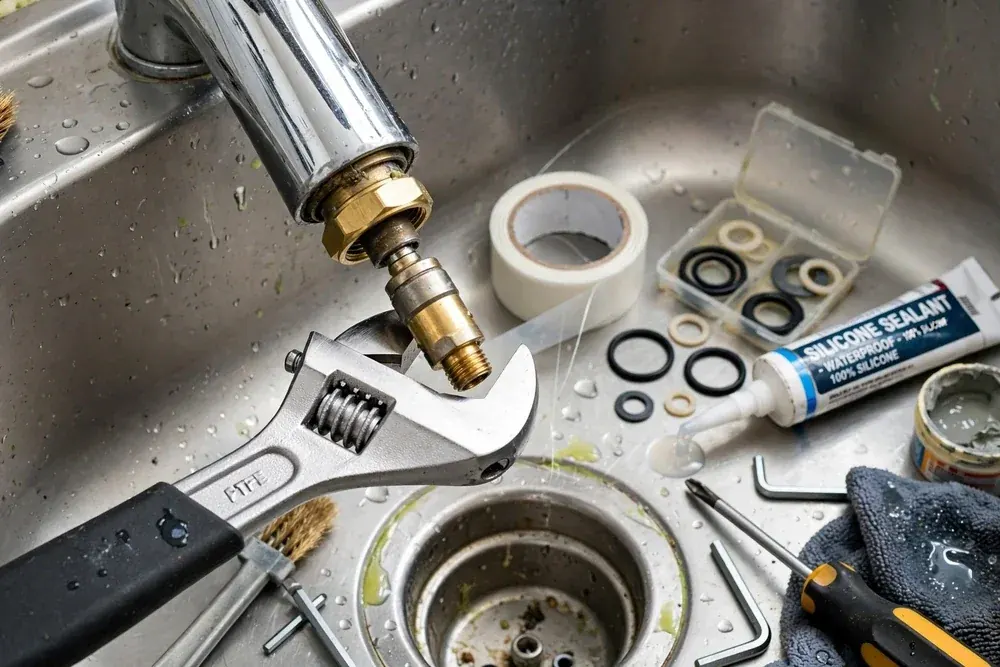
How to Fix a Dripping or Leaking Faucet
Most dripping faucets need one worn part replaced, not a new faucet: a washer, an O-ring, a seat or a cartridge. The fix starts with turning the water off and learning which kind of faucet you own.
This guide covers the four common types, a step-by-step cartridge repair, and the signs that mean you should stop and call a plumber.
Before you touch the faucet: water off first
A faucet repair is a small job until water is flowing where it should not. Do these three things before you pick up a wrench.
Safety setup
- Close the supply valves Look under the sink for two small valves, one for hot and one for cold. Turn each clockwise until it stops, then open the faucet to confirm the flow dies.
- If a valve will not turn Do not force an old, crusty valve. Shut off the main water valve where the line enters the house instead, and open a faucet to relieve the pressure.
- Plug the drain A small screw or washer dropped down an open drain is gone. Put a rag or stopper in the basin first.
Which faucet do you have, and what usually fails?
The handle gives it away. Match what you see to the row below, since the repair depends on the type.
| Type | How to spot it | Part that usually fails |
|---|---|---|
| Compression | Two handles that you turn several times to close | Rubber washer and brass seat |
| Cartridge | Single handle or two handles with a smooth, short turn | The cartridge or its O-rings |
| Ball | Single handle over a rounded cap | Springs, seals and the ball itself |
| Ceramic disc | Single handle that lifts and swings, with a wide body | The disc seals |
Where the water appears also tells you something. A drip from the spout points to the seat, washer or cartridge. Water around the handle or the base points to O-rings.
Parts store trip not going well?
Call the number on this page and describe the faucet. We can line up a licensed plumber and give you a clear price before work starts.
Replacing a worn cartridge, step by step
This sequence fits a common cartridge faucet. Other types follow the same pattern with different parts.
- Pop off the handle capA small decorative cap hides the screw. Pry it up with a flat blade and remove the screw.
- Lift the handle and the retaining nutTake off the handle, then unscrew the nut or clip that holds the cartridge in place.
- Pull the old cartridgeNote the direction it faces before it comes out. Take the cartridge with you to the store, because sizes and shapes vary widely between makers.
- Clean the faucet bodyWipe out mineral deposits and grit with a rag. Dirt left in the body shortens the life of the new part.
- Fit the new cartridge and reassembleSeat it facing the same way, tighten the nut by hand plus a quarter turn, and replace the handle.
- Test slowlyOpen the supply valves a little at a time, run the faucet, and check under the sink for drips.
When the drip is not the faucet
Sometimes you repair the faucet and the leak stays. A worn shutoff valve under the sink can weep at the stem, and the supply line connecting it can fail at the nut. If the cabinet floor is wet after you fix the faucet, the problem sits lower. According to EPA's WaterSense guidance, dripping faucets and worn valves are among the most common household leaks, so fixing one promptly is worth the effort.
A broken shutoff valve is a short plumber job, but it can also be the first sign of an old, corroded fixture set. In that case faucet repair often turns into replacing the valve and the line together, which prevents the next failure.
Aerator first
If the stream is weak, sprays sideways or sputters, the cause is often the aerator at the spout tip. Unscrew it, rinse out the grit and soak it in vinegar to loosen mineral buildup. Reinstall it and test again before taking anything else apart.
Stop and call a plumber if you see these
A DIY repair has limits. These signs mean the job is bigger than a part swap.
- A shutoff valve that will not close Without a working shutoff, every repair means shutting off the whole house.
- Water behind the wall A damp wall or a stain below the sink may mean a leak inside the wall, where a faucet repair will not help.
- Corroded or stripped threads Forcing a fitting can crack the pipe and turn a drip into a flood. If that happens, burst pipe repair is the call to make.
- Repeat leaks after a new part A seat that is pitted or a body that is worn out means the whole faucet needs replacing.
California requires a contractor license for work worth one thousand dollars or more in labor and materials, so check any plumber at cslb.ca.gov.
Wasco note: read the city report before blaming your faucet
Wasco's water comes from groundwater wells, and the city's 2022 water quality report does not list a hardness figure. So you cannot assume how much mineral scale your faucets will collect. A hardness test strip from a hardware store tells you what your own tap delivers.
The same report shows a chlorine residual in the distribution system, which is normal for treated water and is the reason some taps smell faintly of chlorine. Rubber washers and O-rings also wear with age, so check how old they are before assuming the faucet is defective. Homes in Shafter and McFarland draw from different city systems, so scale and wear patterns can differ there.
What a plumber adds to the repair
A plumber replaces the faucet when parts are no longer made or the body is worn. We can also install a new faucet, valve and supply lines at the same visit, which saves a second trip. For jobs that include changing the fixture layout, plumbing installation covers the new connections.
You get a clear price before work starts. If the faucet is leaking while you wait, keep the supply valves closed and call the 24/7 line.
Faucet repair questions
The valve seat under the washer may be pitted, so the new washer cannot seal against it. A rough seat can be reground or replaced.
If the faucet is old, replacing the whole faucet is often the better use of your time.
Water at the base usually means worn O-rings on the spout or cartridge. Shut off the water, remove the spout or handle, and replace the rubber rings.
Coat the new rings lightly with plumber's grease before reassembly.
A drip adds up over days and months, and EPA says the average household's leaks can waste more than 9,300 gallons of water every year. Faucets are among the common sources.
Fixing a drip is usually a small repair compared with a high water bill.
The city's water conservation chapter treats leaks as water waste and presumes that 48 hours after discovery is a reasonable time to fix one.
A dripping faucet is not a crisis, but do not leave a running leak for weeks.
Repair makes sense when only the cartridge or seals have worn out and the finish is sound. Replace the faucet when the body is corroded, parts are hard to find or repairs keep failing.
If you are unsure, a plumber can look at it and tell you which route costs less in the long run.
Done with the drip
Call the number on this page if the repair is stuck, the valve will not close, or water is spreading. Same-day appointments are offered when available.