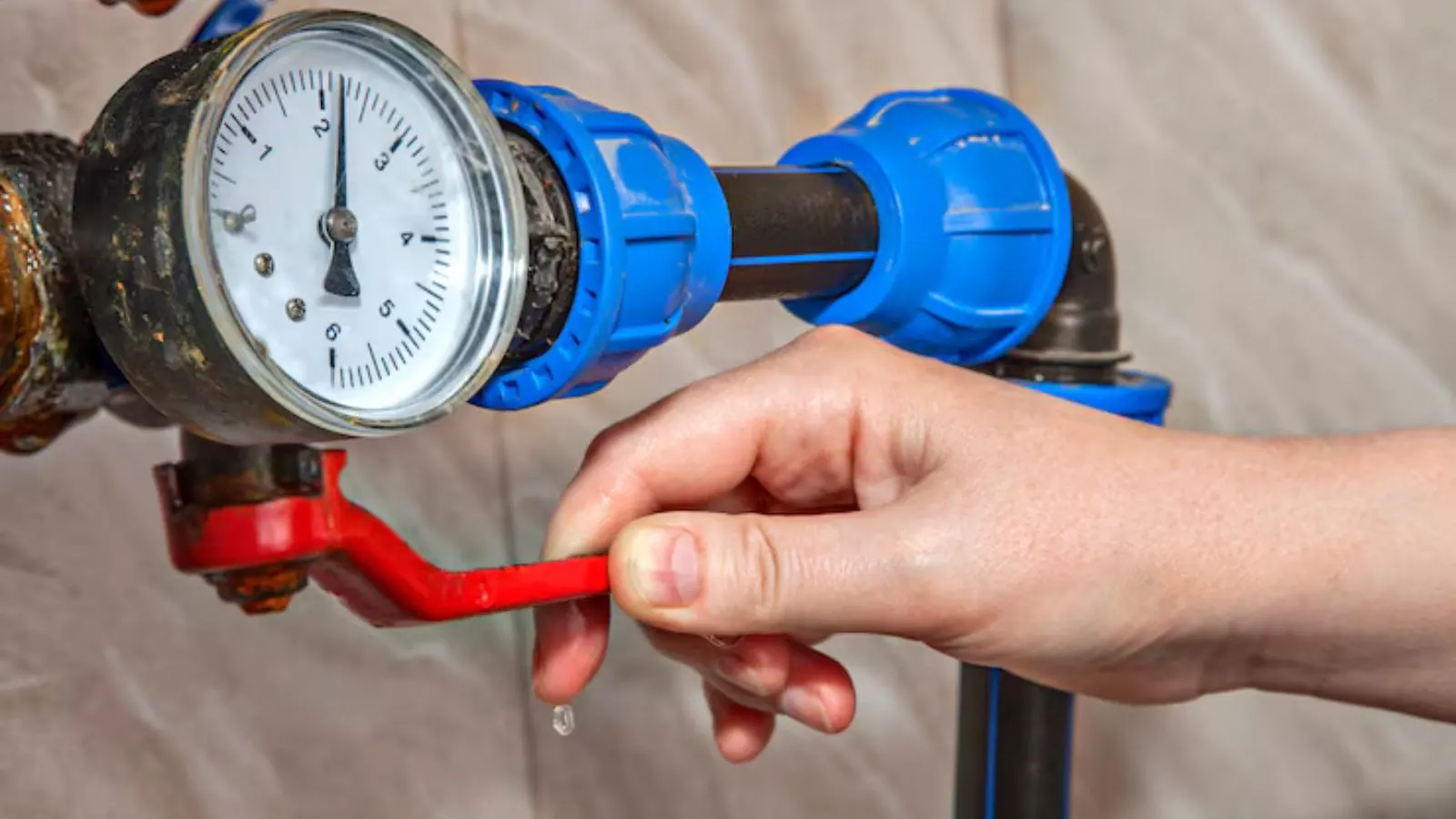
Whole-House Low Water Pressure: Where the Problem Usually Sits
When water pressure is low at every tap, the cause is almost never one faucet. It is usually a shutoff valve that is not fully open, a failing pressure regulator, a leak or corrosion in the line from the meter, or aging pipe inside the house.
A simple gauge on an outdoor spigot and a few quick checks tell you which of those you are dealing with, and whether the city should be called instead of a plumber.
Where pressure gets lost, from the street to the faucet
Follow the water in the order it travels. The point where the pressure drops tells you whose problem it is.
| Location | What it looks like | Who fixes it |
|---|---|---|
| City main or supply | Neighbors have weak pressure too, at the same times | The water utility |
| Main shutoff or meter valve | Sudden loss after work on the plumbing, valve handle partly turned | Homeowner, or a plumber |
| Pressure regulator | Flow drops or swings, sometimes noisy | Plumber |
| Service line to the house | Gradual loss, wet ground, a meter that moves with all water off | Service line repair |
| Old interior pipe | Weak flow that has worsened over years, brown water at first draw | Repiping plumber |
| One fixture only | A single clogged aerator or valve | Homeowner or faucet repair |
Quick checks that cost nothing
Run these before you pay for a visit. Several take less than a minute.
- Test several taps If only one tap is weak, clean its aerator. If every tap is weak, the cause is upstream.
- Compare hot and cold Low pressure only on the hot side points to the water heater or its shutoff valve, not the whole house.
- Ask the neighbors If the next house has the same weak flow, the problem may be on the supply side.
- Open the main shutoff fully A gate valve left a quarter closed after past work cuts the flow to everything. Turn it fully open.
- Watch the meter With all water off, a moving dial means water is escaping. That can steal pressure from the house.
If the meter is moving, the EPA's two-hour meter test is the next step, and a plumber can locate the loss without digging at random.
Gauge low at rest?
Call the number on this page with your reading. A licensed plumber can scope whether the regulator, the line or the pipe inside is the likely cause.
What a pressure gauge tells you
A plumber measures static pressure with a gauge screwed onto an outdoor hose bib. You can do the same with a hardware store gauge. Read it with every fixture off, then open a tap and watch the needle fall.
As a yardstick, one California utility, San Diego Public Utilities, says a new pressure-reducing valve should be set between 45 and 75 psi. The California Plumbing Code calls for a regulator where static pressure is above 80 psi, with an expansion tank in the cold water piping after it.
If the gauge reads healthy at rest but drops hard when a tap opens, the line is restricted. If it reads low even at rest, the regulator or the supply side is the likelier cause. According to EPA guidance, a water meter reading that changes over two hours with nothing running points to a leak, which can also explain weak pressure.
When the pressure regulator is the culprit
A pressure regulator is a bell-shaped valve near the main shutoff in many homes. It wears out, and a failing one can restrict flow, let pressure creep too high or make a humming noise. Not every house has one, and the gauge reading is the clue.
Replacing a regulator is work for a licensed plumber. Because the code pairs a regulator with an expansion tank in the cold water piping, the plumber may suggest checking that tank while the water is off.
When the cause may be on the City of Wasco's side
The City of Wasco's 2022 water quality report says the city supplies groundwater from six active wells through about 94 miles of distribution lines. The city has also gone through environmental approval for four new wells to replace existing ones, and a treatment project at Well 12.
That work is the utility's business, but it is a reason to ask the city first if your whole street seems weak. If neighbors report the same drop, call the City of Wasco water utility before paying for a diagnostic visit at your own house.
We do not claim any of that work causes low pressure in a given home. If the neighbors are fine and your meter checks out, the problem is probably on your side of the meter.
How a plumber narrows it down
A good diagnosis follows the water from the meter to the faucet and stops at the first restriction.
- Read pressure at rest and under flowA gauge on the outdoor spigot shows whether the supply is weak or the house is restricting it.
- Check the main valve and regulatorA partly closed valve or a tired regulator is the fastest fix on the list.
- Test for a hidden lossA meter test and a listen along the service line rules out a leak between the meter and the house.
- Inspect the interior pipeLooking at an accessible run of pipe can show corrosion that narrows it.
- Explain the options and the priceYou get the finding and a clear price before work starts.
Old pipe and slow decline
Galvanized steel supply pipe corrodes from the inside, and the bore narrows over the years. One plumbing reference puts its typical life at 40 to 60 years, with copper lasting much longer in most conditions. A house plumbed in galvanized often shows weak flow that gets worse slowly, along with rusty water on first draw.
We do not know the pipe materials in Wasco homes from the city's data, so a camera or an access cut is the only way to confirm. If an interior pipe is the problem, repiping replaces the narrowed lines, and a plumber can scope the walls and access points by phone first.
A plumber can also test the line from the meter. If the loss is in the buried service line, the fix is a service line repair, not a whole-house job.
Getting help in Wasco, Shafter and McFarland
We also dispatch to homes in Shafter and McFarland. Low pressure is rarely an emergency, so same-day appointments are offered when available. If you see water pooling, hear a pipe hissing or the meter races with everything off, close the main valve and call the 24/7 emergency line.
Call 811 before any digging near the service line so buried utilities can be marked.
Low pressure questions
That pattern points at the water heater, its shutoff valve or the hot side piping, not the whole house. Sediment, a partly closed valve or corroded fittings can restrict the hot side only.
A plumber can check it during a water heater repair visit.
Yes. A leak in the service line or inside the walls can steal pressure before the water reaches your taps. A moving meter with all water off is the strongest sign.
Check for wet soil, a hissing sound or an unusually high bill.
Call the City of Wasco water utility, since the supply side belongs to the city. The city's water comes from groundwater wells and its own distribution lines, and the utility can tell you if there is work or a problem in your area.
If the utility finds nothing, a plumber can test your side of the meter.
Yes. The California Plumbing Code calls for a regulator where static pressure is above 80 psi. Very high pressure strains fixtures and hoses, while a failing regulator can swing between high and low.
Only if the supply is weak and the pipes are sound. A pump on a restricted or leaking line can make the problem worse. Find the cause first, then decide whether a pump has any role.
Get full flow back
If every tap is weak or the meter moves with water off, call the 24/7 emergency line. Same-day appointments are offered when available, with a clear price before work starts.